
How Much Water Does a Laundry Machine Use
How much water does a laundry machine use, and is there a way to reduce it? Love2Laundry covers what you need to know to make better choices.
Did you know that the average 4-person UK household uses around 450 litres of water every day? Break that down, and it’s about 142 litres per person, per day. It sounds crazy, but the statistics don’t lie, and most of us have no idea how much water gets used between showering, brushing our teeth, washing the dishes, and, of course, laundry.
But how much water does a washing machine use, exactly, and do the machine type, brand, and wash setting impact this? If you want to know, then you’re in the right place.
At Love2Laundry, we’re more than just a laundry service. We like to keep you informed, too. With laundry symbol cheat sheets and guides on everyday laundry problems like making your stinky laundry smell good, weight capacities, and whether laundrettes are hygienic, among other things, so check those out if you’re interested.
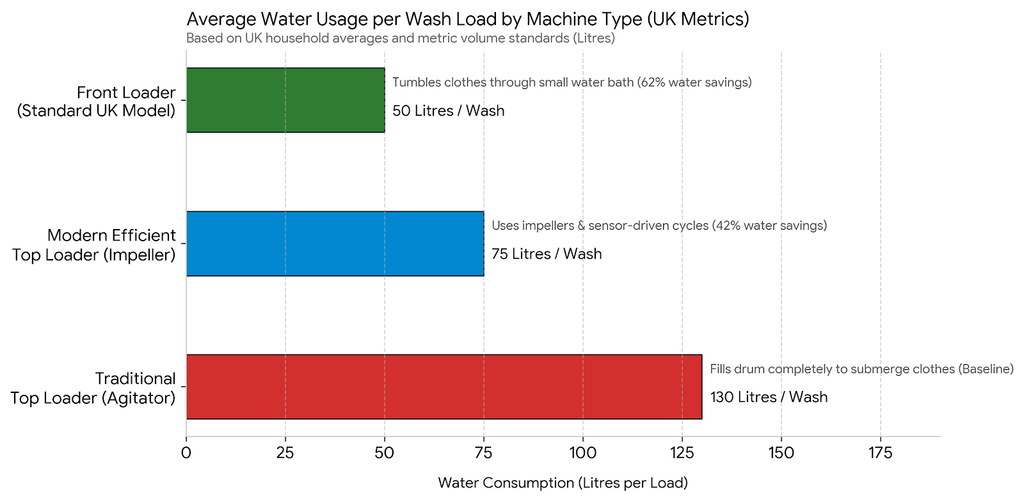
Quick Answer: So, how many litres does a washing machine use? It depends on a few different factors, but the average front-loading machine will use 50 litres for every standard wash. Older machines can use up to 180 litres per wash, and top loaders use anywhere between 120–150 litres.
Different Types of Laundry Machines
Different types of laundry machines will have different water and energy usage. Newer models are likely to be more water-efficient than previous ones, but this is something that you need to look into when comparing models while looking for a new machine.
Some brands make excellent eco models, while others create products that are notably less eco-friendly in terms of water usage.
Looking at the Energy Ratings and Machine Capacities
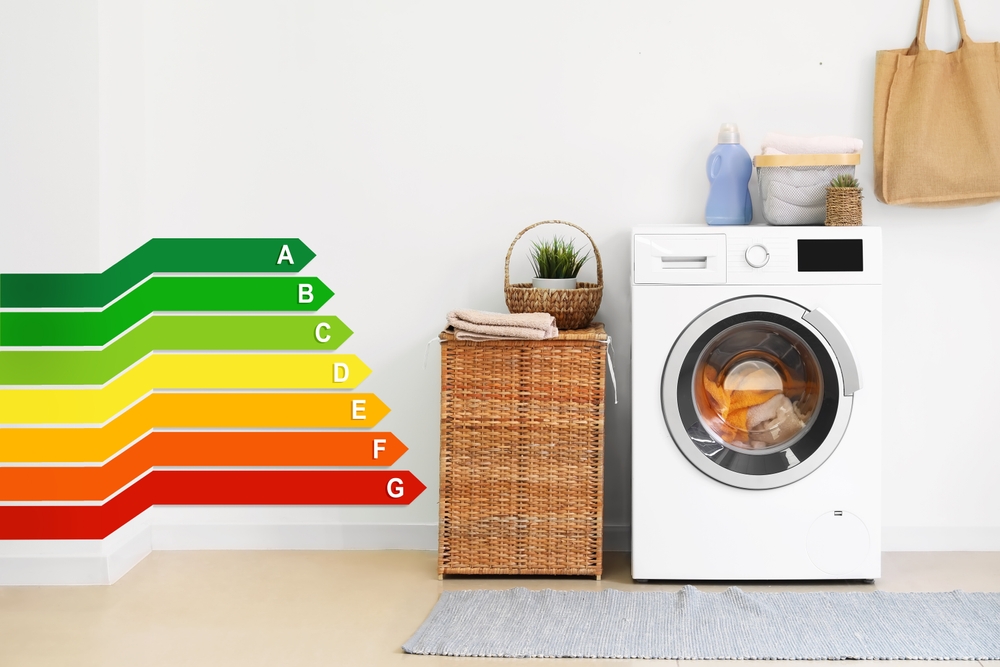
Energy ratings are probably the most important thing to look at when assessing how much water a laundry machine uses, and they often provide useful insight when comparing water consumption. In the UK, there is a strong correlation between energy efficiency and washing machine water consumption, so it is not something to overlook.
For example, the Hotpoint BIWMHG71483UKN 7kg capacity laundry machine with a D energy rating uses 49.3 litres per wash cycle, while the Beko WTIK72111 7kg machine with a C energy rating uses 41.0 litres. The Samsung Series 5 ecobubble™ WW70TA046TE has a B energy rating and uses just 33.6 litres per load.
Below are some different laundry machines and their energy rating (A/B/C/D/E), litres per cycle (l/pc), and litres per capacity for you to compare:
| Capacity | Model | Energy Rating | Litres per Cycle | Litres per kg |
| 7kg | Hotpoint BIWMHG71483UKN | D | 49.3 L | 7.0 L/kg |
| 7kg | Beko WTIK72111 | C | 41.0 L | 5.9 L/kg |
| 7kg | Samsung Series 5 ecobubble™ WW70TA046TE | B | 33.6 L | 4.8 L/kg |
| 8kg | Indesit My Time EWD81483WUKN | D | 53.8 L | 6.7 L/kg |
| 8kg | Beko WTL84121W | C | 45.0 L | 5.6 L/kg |
| 8kg | Hisense WFQA8014EVJMT | A | 32.0 L | 4.0 L/kg |
| 9kg | Hotpoint BIWMHG91484UK | C | 56.1 L | 6.2 L/kg |
| 9kg | LG V3 FAV309SNE | B | 50.0 L | 5.6 L/kg |
| 9kg | Samsung Series 5+ AddWash™ WW90T554DAN | A | 42.7 L | 4.7 L/kg |
| 10kg | Hoover H-WASH 300 H3W4102DE | E | 59.8 L | 5.9 L/kg |
| 10kg | Beko WTL104121W | B | 57.0 L | 5.7 L/kg |
| 10kg | Beko Aquatech® RecycledTub® B5W51041AW | A | 39.0 L | 3.9 L/kg |
| 11kg | Hotpoint ActiveCare NLCD1164DAWUKN | C | 58.4 L | 5.3 L/kg |
| 11kg | Samsung Series 8 WW11BB945DGMS1 | A | 54.0 L | 4.9 L/kg |
| 12kg | LG V7 F4V712STSE | B | 57.0 L | 4.8 L/kg |
| 12kg | Haier i-Pro Series 7 HW120-B14979 | A | 48.9 L | 4.1 L/kg |
Based on the above, you may notice that many of the larger machines (e.g. 12kg capacity) actually use fewer litres of water per kg capacity than the smaller machines, or have very similar numbers. For example, the 7kg Samsung Series 5 ecobubble™ WW70TA046TE (B) uses 4.8 litres per kg capacity while the 12kg LG V7 F4V712STSE (B) uses the same amount, and the 12kg Haier i-Pro Series 7 HW120-B14979 (A) uses just 4.1 litres per capacity.
A bigger washing machine does not always use more water. When we look at water use per kg of laundry, some larger machines use the same amount or even less water than smaller ones. A larger drum can also help you wash more clothes in one go, meaning you may need fewer wash cycles. This can help save water and energy over time. So, when choosing a washing machine, do not only look at the drum size. Also, check the energy rating and how much water it uses per kg of clothes.
What Things Affect Laundry Machine Water Use?
So, how much water does a laundry machine use? The number varies a lot depending on the machine, as we explored above, but also on the settings the machine washes with. Bigger can be better, but this is only the case when you are using the full capacity of the machine and not always doing half-loads.
Does the Size of the Laundry Machine Matter?
The size of your laundry machine may play a role in how much water it will use on any given wash. Larger machines typically require more water for any kind of wash compared to smaller machines simply because of increased capacity.
Do the Wash Settings Make a Difference?
The wash setting you choose will also likely have a direct impact on how much water your laundry machine uses. How long a machine takes will play a role as well, as some washes take longer than others and may therefore use more water.
Quick Wash, Eco Wash, or Express Wash will use the least water in these machines. However, your machine’s make and model will be important when comparing the effectiveness of these cycles, as older machines’ eco cycles will not save as much water as newer models.
Front Loader vs Top Loader Water Usage
The type of washing machine you choose can affect how much water it uses. The two most common types are front-loader and top-loader washing machines. They work differently, which changes how much water they need during a wash cycle.
Front-loader washing machines usually end up using less water because they move the laundry around in a smaller amount of water, instead of just soaking everything. Top-loader washing machines typically use more water, since a lot of them fill the drum with water to submerge the clothes fully. That said, the newer top-loader units have gotten better, and some energy-efficient models can end up using less water than older designs, even with that “fill it up” reputation.
This does not mean that every front-loader will always use less water than every top-loader. The amount of water used depends on the machine model, its energy rating, wash settings, and how much laundry is inside the drum.
When comparing washing machines, it is useful to look at the litres used per wash cycle and the water used per kg of laundry. This gives a better idea of how efficient a machine really is.
Let Love2Laundry Help
At Love2Laundry, we offer easy online services to help you take a load off in your busy life. Our app is perfect for anyone who wants to get their laundry done like Uber Eats so that they can spend more time doing what really matters. Drop your laundry off in London, Manchester or another one of our locations, or call us so that we can pick it up and get it back to you within 24 hours. With no extra hassle.
If you want to use our renowned services, follow these simple steps and make your laundry life easier than ever before:
- Head to our website or app and place your order.
- Select a date and time you would like us to collect your items.
- We collect your items at the designated time.
- We clean your items and can also dry and iron them, depending on the service you opt for.
- We return your items to you. Orders are always aimed to be delivered within 24 hours.
Get in touch and get 25% off your first order as a new customer. Fresh clothes and neat laundry await.
Contact Love2Laundry to Make Your Laundry Life Easier
At Love2Laundry, we’re proud of our sustainable laundry practices and have put in the effort to make our services better than the top contenders like Circuit Laundry. Our pickup services are reshaping lives, allowing you to spend more time doing what you love instead of spending hours on household chores.
If you think pickup laundry services would be a good fit for you, why not give us a call to learn more using the phone number or email address below?
Phone
0203 600 0296
info@love2laundry.com
FAQs
How much water does a front loader use compared to a top loader?
Front-loader washing machines conventionally use less water than top loaders because they clean clothes by moving them around in a small amount of water instead of filling the drum completely. Many front loaders use around 40–60 litres of water per wash cycle. However, water usage can vary depending on the model, wash cycle, and efficiency rating.
Does a bigger washing machine use more water?
A bigger washing machine does not always use more water. Larger machines may use more water for a single wash because they can hold more clothes, but they often use less water when measured per kg of laundry. This means a 10kg or 12kg machine can sometimes be just as efficient, or even more efficient, than a smaller machine. When comparing washing machines, it is better to check the litres used per cycle and litres per kg instead of only looking at the drum size.
Which wash cycle uses the least water?
The wash cycle that uses the least water is often called an eco cycle, because it’s set up to get the clothes clean while using less water and also less energy. The short or quick wash cycles can use less water too, especially if your loads are smaller and the clothes aren’t that soiled. But the real amount of water you use really depends on the washing machine model and on what exact settings you choose.
How can I reduce my washing machine’s water usage?
You can cut down on your washing machine water use by running full loads instead of doing several small washes, one after another. Picking eco-friendly cycles, going for a briefer program when it fits, and buying a more efficient washer with a higher energy rating can all help save water. Also, skipping unnecessary extra rinse cycles is another easy way to reduce how much water gets used.