
The Infographic Guide to Laundry and Washing Symbols
Welcome to the ultimate infographic guide to understanding laundry washing symbols.
Most of us are excited to go shopping for brand new clothes. We imagine ourselves in them and how we’ll feel wearing them. Right before you walk up to the register, you may quickly scan the tag for the fabric type, size, and care label. But this is where many of us get stuck: we see a bunch of shapes we don’t understand and take a guess at how to clean our items.
When we see familiar laundry symbols like the outline of a tub with a number on it, we assume we’re supposed to wash our clothes, but not everyone knows which washing machine settings to apply.
Before you continue reading, why not stop and try to recall all the laundry symbols you’ve memorised off the top of your head?
Depending on how you interpret each symbol, you may unknowingly be damaging some of your favourite garments. In this article, we’ll cover the most common washing, bleaching, drying, ironing, and professional cleaning symbols. Take the time to review every care label, as each represents a different action that will help prolong the life of your fabrics. Your next load of laundry could be the last time you ever worry about shrinking or ruining your clothes.
What Do Laundry Symbols Mean? (Quick Answer): Laundry symbols are standard signs on clothing care labels that tell you how to wash and care for your clothes. There are five main symbol groups: a wash tub for washing, a triangle for bleaching, a square for drying, an iron for ironing, and a circle for professional cleaning. These symbols follow an international care-labelling system developed by GINETEX, the global body responsible for textile care labelling.
WASHING Symbols
About time you learned how to sort out your load of laundry more thoroughly than just setting whites and colours aside. Some of your bedding, garments, and fabrics require a bit more attention. Washing machine symbols are explained below, and you are most likely to encounter them on a care label.
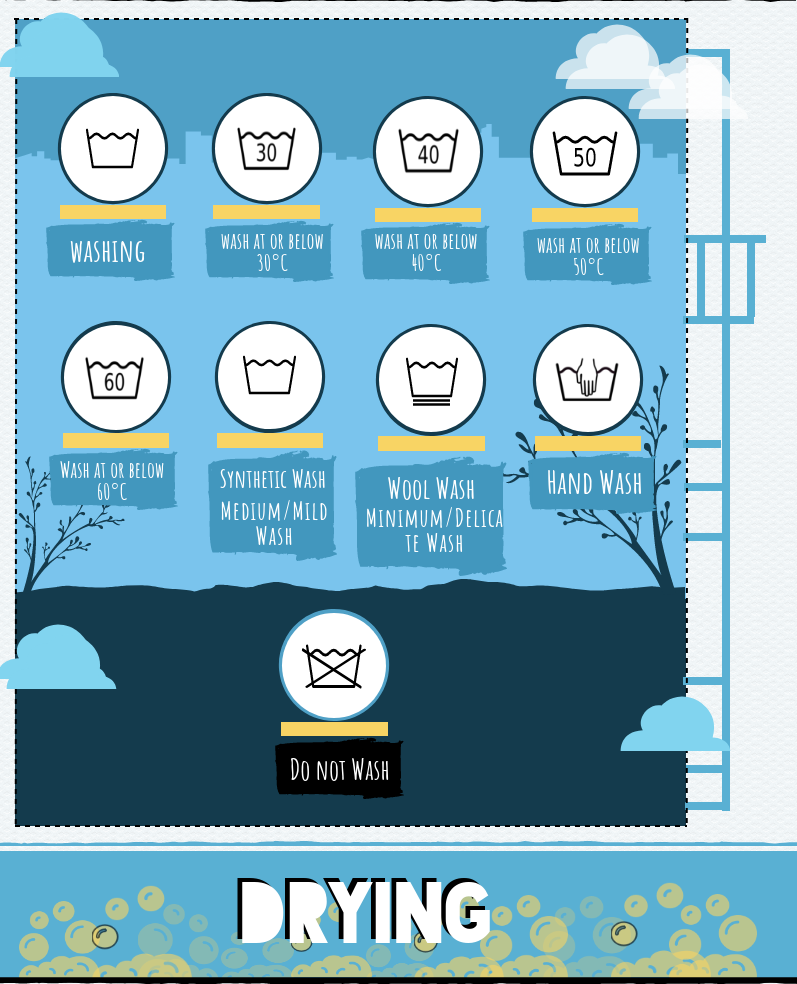
The most important image to look out for is the outlined wash tub; once you understand it, washing symbols become far less intimidating.
Pro Tip: Not sure whether to wash at 30°C or 40°C? Read our guide to the ideal temperature for a cold wash to pick the right setting for your load.
| Symbol Description | What It Means |
| Washtub (no number) | It means you can wash everyday fabrics (not delicate ones) in the washing machine using whatever cycle suits you best. |
| Washtub with ’30’ | Wash in the machine at a maximum of 30°C. This gentle wash is ideal for lightly soiled clothes, delicate colours, or items prone to shrinking. |
| Washtub with ’40’ | Wash in the machine at 40°C, a warm wash that’s effective for everyday clothing like T-shirts, jeans, and mixed loads. |
| Washtub with ’50’ | Wash at a maximum of 50°C, a moderately hot wash good for heavily soiled items or fabrics that need a deeper clean, like towels and bedding. |
| Washtub with ’60’ | Wash at 60°C, a hot wash best suited for more heavily soiled items, whites, or anything that needs thorough sanitising, such as bed linen or kitchen cloths. |
| Washtub with a hand | This means a delicate item that needs extra care. Either hand wash gently in cool water or use your machine’s gentle cycle. |
| Crossed-out wash tub | Do not wash this item in water at all; it will likely require dry cleaning or another cleaning method instead. |
DRYING Symbols
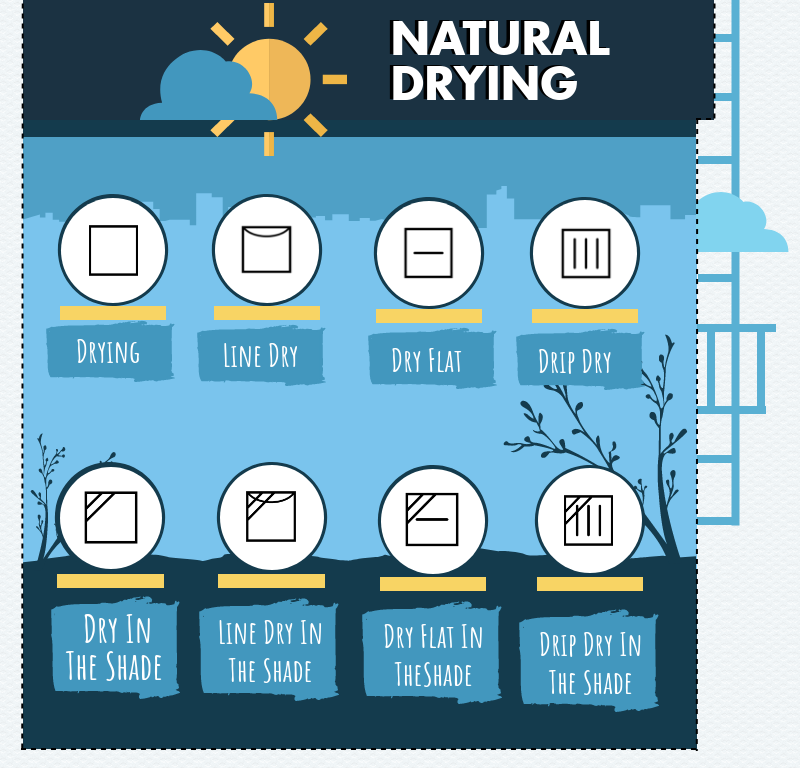
The easiest way to spot a care label related to drying is to look out for a square. Squares represent both types of drying that may be applied to various fabrics: natural drying and tumble drying. Once you’re familiar with these laundry symbols, you’ll never second-guess a care label again.
Natural Drying
| Symbol Description | What It Means |
| Plain square | Keep away from the washing machine; dry this item naturally |
| Square with a curved line (top corners) | Line dry: hang the item naturally on a clothesline. |
| Square with a horizontal line at centre | Dry flat: lay the item out flat to dry. Prevents stretching on sweaters or knitted garments. |
| Square with three vertical parallel lines | Drip dry; do not wring or tumble dry, or the fabric will crease. |
| Square with two slanted lines (upper left corner) | Dry in the shade; dry naturally but away from direct sunlight. |
| Square with two slanted lines + curved top line | Line dry in the shade; hang on a clothesline, away from sun exposure. |
| Square with two slanted lines + horizontal centre line | Dry flat in the shade; lay flat and keep away from direct sunlight to preserve quality. |
| Square with two slanted lines + three vertical lines | Drip dry in the shade; hanging or tumble drying may cause creasing or shrinkage |
Tumble Drying
You can easily distinguish natural drying symbols from tumble dry symbols by spotting the circle enclosed within a square. For a deeper look at what tumble drying involves, see our guide to tumble drying.
| Symbol Description | What It Means |
| Circle enclosed in a square | This tumble dry symbol means the item is tumble dryer friendly. |
| Circle with one dot, enclosed in a square | Low heat tumble drying: use a low temperature to avoid damaging the item. |
| Circle with two dots, enclosed in a square | Normal heat tumble drying: a standard heat setting is safe for this item. |
| Circle with three dots, enclosed in a square | High heat tumble drying: this item can withstand a higher temperature setting. |
| Crossed-out circle and square | Do not tumble dry: keep this item away from the tumble dryer entirely. |


IRONING Symbols
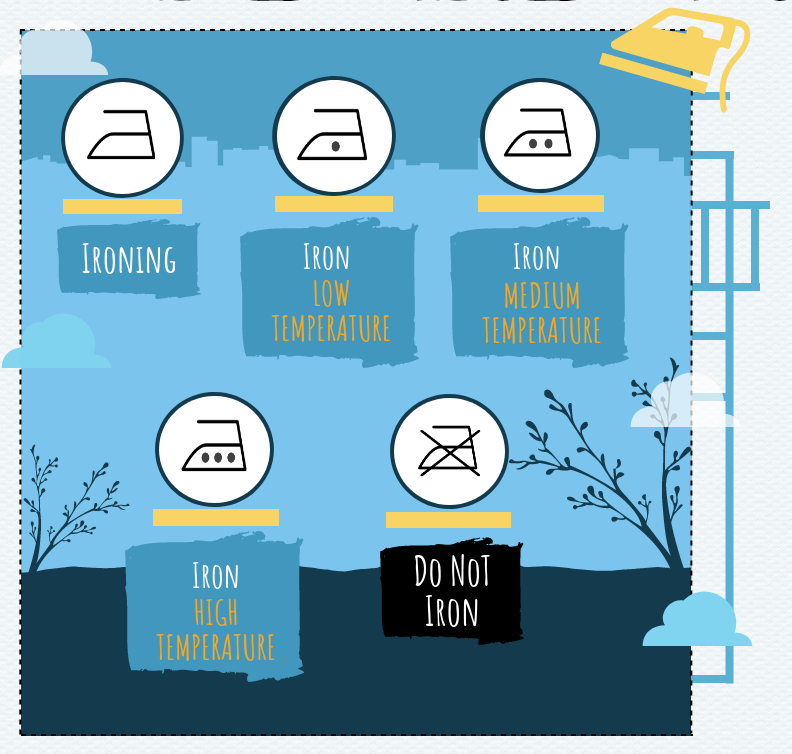
Ironing care labels are relatively straightforward to remember. The outline of an iron is used to advise you on the best ironing practices for your fabrics. Once you know the iron symbol meaning, the number of dots tells you everything you need to know about temperature.
| Symbol Description | What It Means |
| Plain iron outline | You may iron the item as you see fit; no recommended temperature restriction. |
| Iron with one dot | Low temperature typically reserved for delicate fabrics such as silk. |
| Iron with two dots | Medium temperature commonly found on synthetic fabrics. |
| Iron with three dots | High temperature: iron the item at a high heat setting. |
| Crossed-out iron | Do not iron this item. |

BLEACHING Symbols
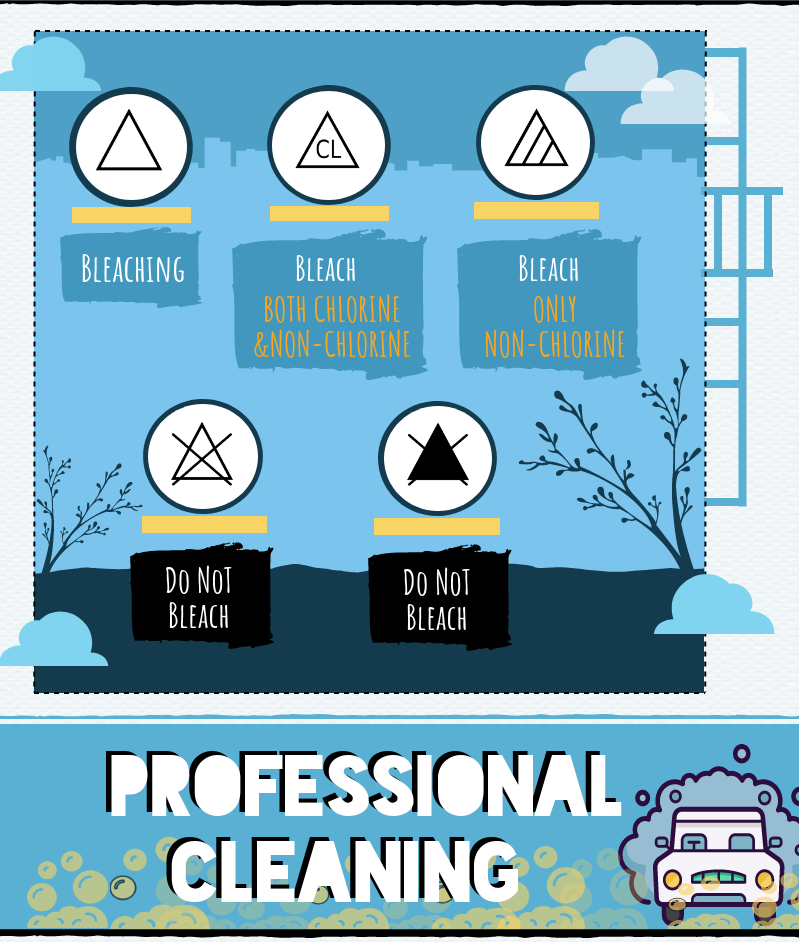
Bleaching care symbols direct you on what type of bleach you may apply to your garments. Your options will typically be between chlorine and non-chlorine solutions.
| Symbol Description | What It Means |
| Plain triangle | Standard bleaching symbol: the fabric may be bleached with both chlorine and non-chlorine solutions. |
| Triangle with ‘CL’ inside | Chlorine bleach allowed; both chlorine and non-chlorine solutions can be used. Often found on older items, as the plain triangle has largely replaced this symbol. |
| Triangle with two parallel diagonal lines across it | Non-chlorine bleach only; do not use chlorine-based solutions on this item. |
| Crossed-out triangle (darkened or plain) | Do not bleach this item under any circumstances. |
PROFESSIONAL CLEANING Symbols
You would probably refer to professional cleaning as dry cleaning. And even though you hand these items over to trained laundry specialists, it can be useful to know what’s happening to your suits and expensive jackets while they’re being cleaned.
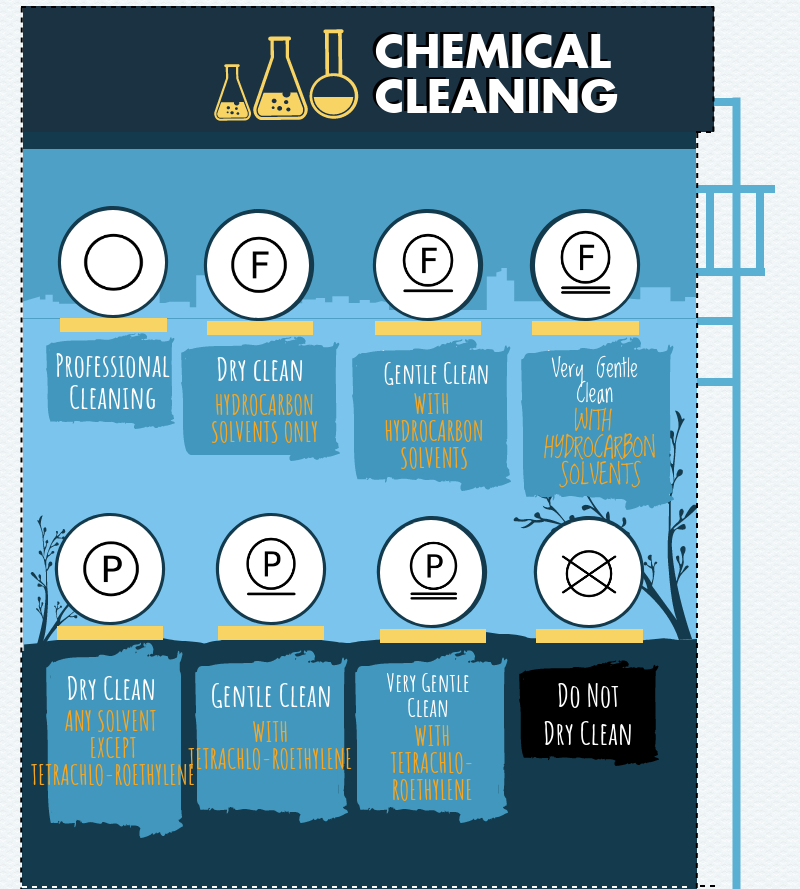
Professional cleaning generally falls into two categories: chemical cleaning and wet cleaning. Both are depicted by a circle. The letters ‘F’ and ‘P’ are used to describe chemical washes, while the letter ‘W’ signifies a wet clean. The number of bars under a professional cleaning symbol determines how gentle the washing has to be.
Chemical Cleaning
Professional cleaning symbol: A circle indicates that you ought to trust your item to a specialist.
Dry clean, hydrocarbon solvent only (HCS): This type of wash is represented by the letter ‘F’ enclosed by a circle. The ‘F’ tells your laundry specialist to clean your item with hydrocarbon solvents only.
Gentle cleaning with hydrocarbon solvents: You will find the letter ‘F’ enclosed by a circle and bar underneath.
Very gentle cleaning with hydrocarbon solvents: This symbol is typified by letter ‘F’ enclosed by a circle and a double bar underneath.
Dry clean, any solvent except tetrachloroethylene: This care label features a letter ‘P’ enclosed by a circle. The ‘P’ is the shortened version of the abbreviation PCE which stands for the solvent, tetrachloroethylene. The ‘P’ asks your laundry professional to clean your item with any cleaning solution EXCEPT tetrachloroethylene.
Gentle cleaning with PCE: You will find the letter ‘P’ enclosed by a circle with a bar underneath.
Very gentle cleaning with PCE: You will see the letter ‘P’ enclosed by a circle with a double bar underneath.
Do not dry clean: A crossed out circle indicates that you are not to dry clean your fabric.
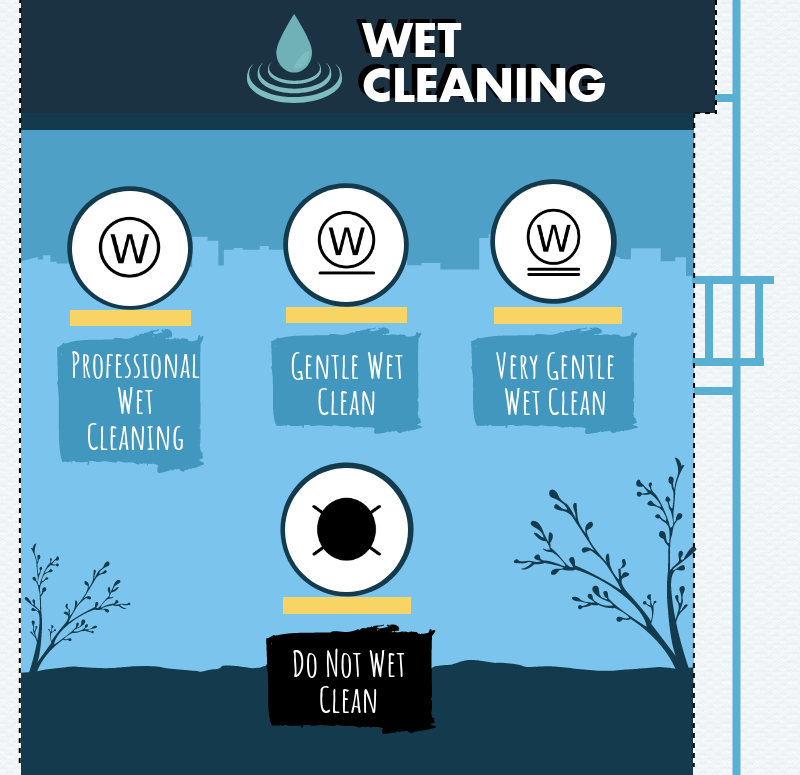
Wet Cleaning
Professional wet cleaning: The care label is represented by a circle with the inscription ‘W.’ The letter stands for WET CLEANING.
Gentle wet cleaning: We see the line again underneath the ‘W’ enclosed by a circle.
Very gentle wet cleaning: The ‘W’ enclosed by a circle sits above two lines, indicating a more gentle type of clean than above.
Do not wet clean: A black circle is cancelled out to help differentiate between the ‘do not dry clean’ symbol.
Frequently Asked Questions
What does a number inside a wash tub symbol indicate?
The number shows the maximum temperature at which you can machine wash the item. For example, a wash tub with ’30’ means wash at no more than 30°C, and ’60’ means up to 60°C.
How is the natural drying square different from the tumble dry symbol?
A plain square represents natural drying, while a circle inside a square means the item can be tumble dried. If you see a circle, a machine can do the work; a plain square means air dry only.
What do the dots inside an iron symbol tell you?
The dots represent the safe temperature at which ironing can be done. A single dot means that lowest temperature setting; two dots represent medium temperature, while three dots show that it is safe to use high temperature for ironing.
What does a crossed-out symbol on a care label mean?
A crossed-out symbol means that particular action must be avoided entirely. A crossed-out wash tub means do not wash, a crossed-out iron means do not iron, and a crossed-out circle means do not dry clean.
Conclusion
At this point, you have either become the master of care labels, or you have become overwhelmed. There are quite a few laundry care labels to keep up with. Regardless of which side you fall on, Love2laundry is here to take care of your laundry needs.
We know every care label, backwards and forwards. And your satisfaction is our number one priority. Not only will we translate your laundry symbols into expert care, but we will also pick up your dirty laundry from your door. Contact us today to learn how we deliver your cleaned, ironed and folded items back to you within 24 hours.
We look forward to hearing from you.